Everyone assumes they’ll manage the robots.
They won’t.
Here’s the uncomfortable math: if AI truly becomes capable, you won’t need many managers. The ratio could be 1:1000. One human with good judgment orchestrating a digital workforce that never sleeps.
The World Economic Forum’s Future of Jobs Report 2025 projects 170 million new jobs created globally by 2030, while 92 million existing roles face displacement. That’s a net gain of 78 million jobs. The headlines will call this a win. But 92 million people losing their jobs and 170 million new jobs appearing aren’t the same 92 million people.
We’re not witnessing job destruction. We’re witnessing a sorting. We can be accelerationist and drive with intentionality, and history serves as a guide for how we might handle this well.
We’ve Done This Before
The shift from agriculture to industry took 200 years. In 1790, 90% of Americans farmed. Today it’s under 2%.
That transition created enormous wealth. It also created enormous suffering.
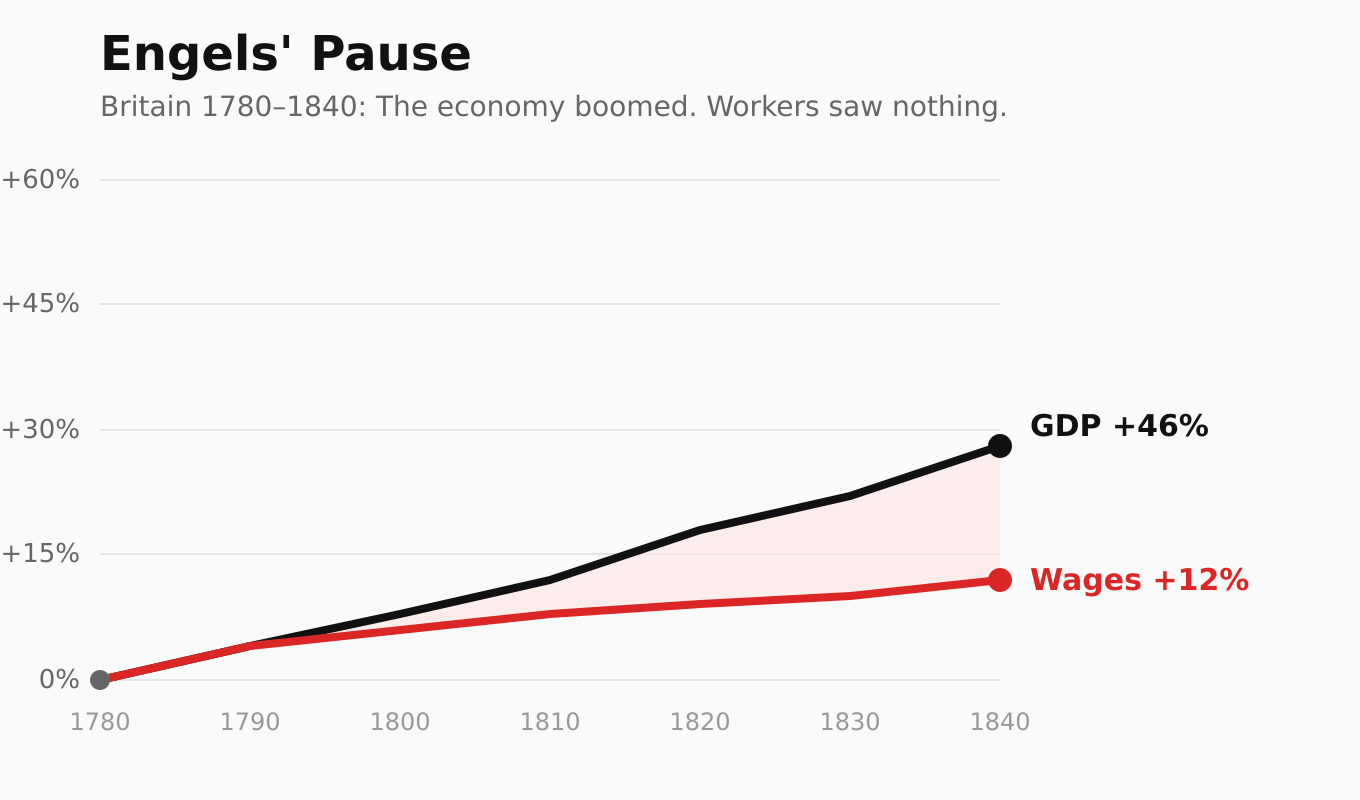
British workers experienced what economists call “Engels’ Pause”: from the 1780s to the 1840s, GDP grew 46% while working-class wages grew just 12%. Real wages stayed flat for 50 years before they finally rose.
AI is moving faster. According to Stanford’s AI Index 2025, business AI adoption jumped from 55% to 78% in a single year. The WEF reports that 86% of employers expect AI and information processing technologies to transform their business by 2030. We’re compressing a century of disruption into a decade.
The question isn’t whether the sorting happens. It’s whether we navigate it better than our great-great-grandparents did.
The Five Buckets
Every job will land somewhere. Here’s a crude framework to help:
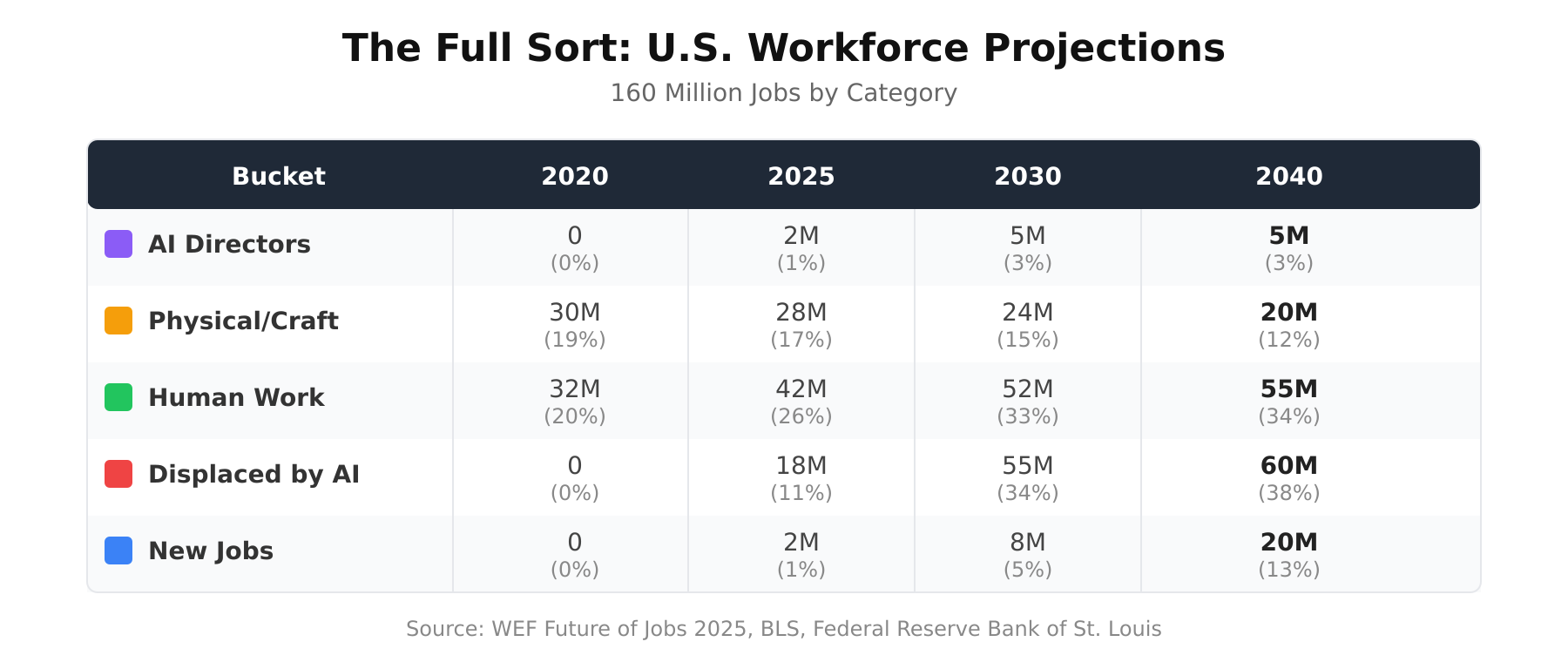
Bucket 1: AI Directors Humans who direct AI systems. Judgment, taste, goal-setting. This category barely existed before ChatGPT. It will grow fast in the coming years, likely peak around 5%, then contract as AI becomes more capable and needs fewer managers. Current trajectory: 0% → 3% by 2040.
Bucket 2: Physical/Craft Work requiring physical presence in unpredictable environments. Electricians, surgeons, carpenters. Moravec’s Paradox holds: robots can beat grandmasters at chess but struggle with physical manipulation in novel contexts. The BLS projects construction alone needs 439,000 additional workers in 2025. Slow decline, but not a collapse. Current trajectory: 19% → 12% by 2040.
Bucket 3: Human Work Care, connection, and creativity. Nurses, therapists, teachers, artists. Work where human presence IS the product. Healthcare is already the largest U.S. employment sector at 17+ million workers. Nurse practitioners are projected to grow 52% from 2023 to 2033. The growth story. Current trajectory: 20% → 34% by 2040.
Bucket 4: Displaced by AI Jobs eliminated or reduced beyond recognition. Admin, routine analysis, bookkeeping, paralegals, most middle management. Federal Reserve research shows occupations with higher AI exposure have experienced measurable unemployment increases since 2022, with a correlation coefficient of 0.57 between AI adoption intensity and unemployment gains. The big number. Current trajectory: 0% → 38% by 2040.
Bucket 5: New Jobs Roles that don’t exist yet. Historical precedent: 60% of jobs in 2018 didn’t exist in 1940. AI-related positions grew 25% year-over-year in Q1 2025. AI engineer demand increased 143% in a single year. The unknown that determines whether this transition is navigable. Current trajectory: 0% → 13% by 2040.
The Full Sort
Where the Displaced Go
60 million Americans will see their jobs fundamentally change or disappear. Where do they land?
Some retrain into new roles. Some transition to human-centric work. Some move into physical/craft trades. Some retire early. Some are supported by family. Some by whatever safety net we build.
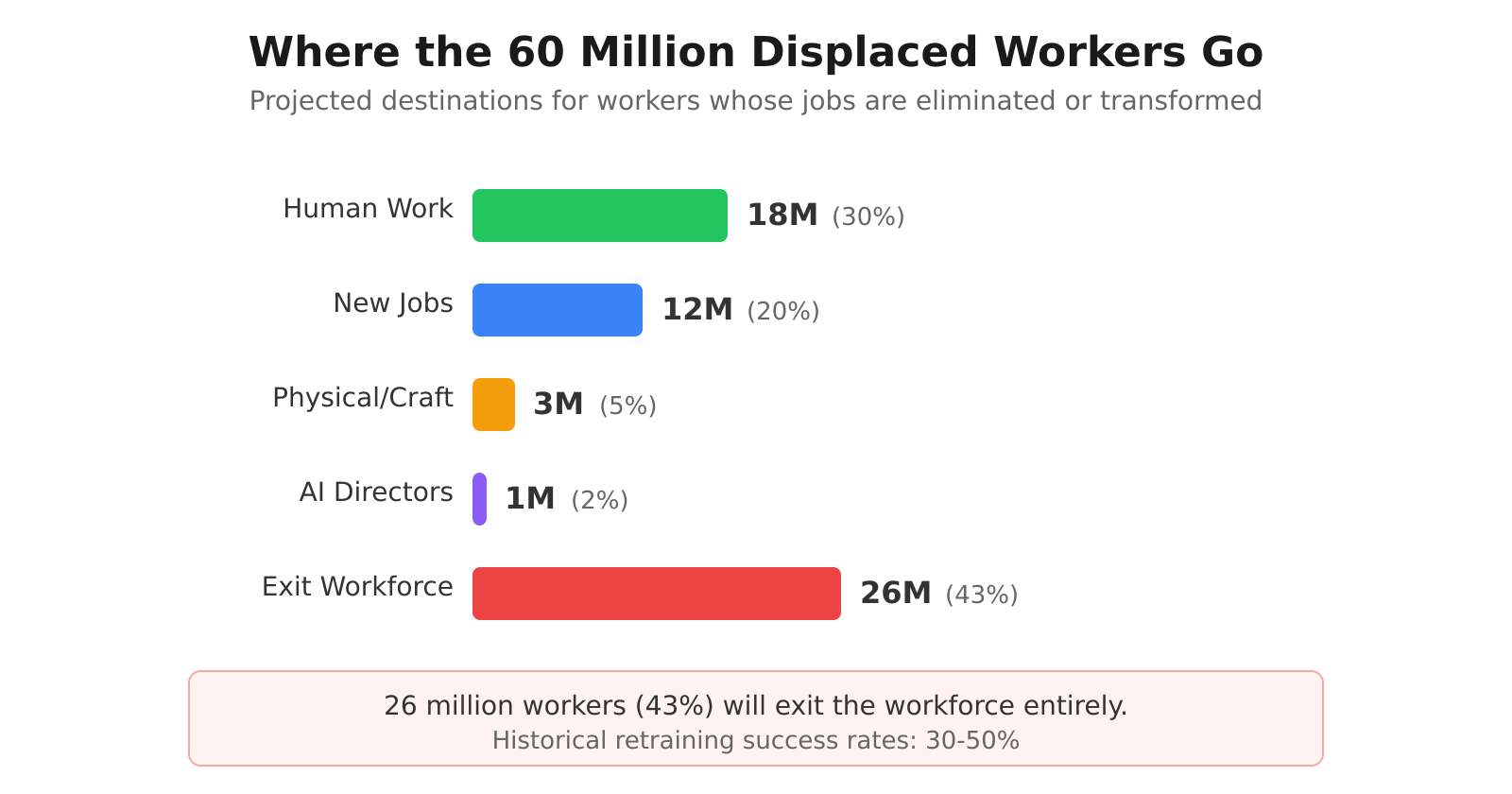
That last category is uncomfortable. Historical retraining success rates run 30-50%. Roughly 26 million who don’t find new work.
This isn’t failure. It’s math. The Finland UBI experiment found that money helped wellbeing even without employment. But money isn’t enough. Jobs provide structure, identity, and community.
The question is how well we navigate it.
The Human Premium Is Real
Research consistently shows people prefer human-created work, even when quality is equivalent.
In healthcare: Studies show patients choose human doctors over AI at higher rates, even when diagnostic accuracy is equivalent. 42% of healthcare professionals remain unenthusiastic about AI, citing human interaction concerns.
In creative work: A 2023 study published in Scientific Reports found people devalue art labeled as AI-made across multiple dimensions, including beauty, profundity, and monetary worth, even when they report the work is indistinguishable from human-made art. Six experiments with nearly 3,000 participants confirmed these effects.
In commerce: Research in the Journal of Consumer Behaviour found consumers consistently prefer human-generated artwork, driven by reduced empathy with AI generators and weakened social identification. MIT research documents premiums of 20-50% for goods and services people believe involve human expertise.
This isn’t irrational. It’s deeply human. We want to be seen by someone who has also suffered, also loved, will also die.
The human premium isn’t charity. It’s market signal.
What Actually Helps
The human premium research points somewhere specific: people pay more for human involvement. That’s not a policy problem. That’s a market signal.
The companies that capture it will be the ones that deliver human-directed AI at scale. Not AI that replaces humans. AI that multiplies them.
1. Sell capacity, not efficiency. The wrong frame: “AI makes workers 30% more efficient, so we need 30% fewer workers.”
The right frame: “AI gives workers 30% more capacity, so they can serve 30% more customers.”
Efficiency is a cost story. Capacity is a growth story. The consultant who serves 15 clients instead of 5 isn’t cheaper. They’re bigger. They capture more market. They build deeper moats.
The market mechanism is simple: leveraged humans out-earn unleveraged ones. Firms that multiply their people will outcompete firms that cut them. The math does the work.
2. Make governance the product. Nobody cares whether a human typed every word. They care whether a human with judgment is accountable for the outcome.
A legal brief drafted by AI and governed by an attorney who stakes their reputation on it beats one assembled by a junior associate. The governance layer is what customers are buying.
This is a positioning opportunity. The companies that make the human-in-the-loop legible to customers will command the premium. Not “Certified Human-Made” theater. Clear answers to: Who directed this work? Who made the judgment calls? Who stands behind the outcome?
The demand exists. The companies that package it well win.
3. Sell the job people wanted. Most knowledge workers experience a meaning deficit. They became advisors to guide clients. They spend their days on compliance forms. They became teachers to inspire. They spend their nights grading.
The parts of the job they wanted are buried under the parts that don’t require their judgment.
AI offers to give work back. When documentation and busywork move to machines, what remains is judgment, relationships, decisions that matter. The job becomes the job they wanted when they chose the career.
This is a recruiting advantage. A retention advantage. An engagement advantage. The firms that frame AI as “reclaim your craft” will attract better talent than firms that frame it as “do more with less.”
4. Win by multiplying, not replacing. The companies that deploy AI to cut headcount will capture short-term margin. The companies that deploy AI to multiply human reach will capture markets.
A professional services firm that uses AI to let each expert serve 3x the clients doesn’t have 3x the cost savings. It has 3x the revenue. 3x the relationships. 3x the moat.
The human premium research says people want humans in the loop. The market opportunity is being the company that delivers human-directed service at a scale that wasn’t previously possible.
That’s not “humans versus AI.” It’s humans with AI leverage competing against humans without it. The leveraged humans win. Their firms win. The market sorts itself.
The Path Forward
The mistake is framing this as humans versus AI. The sorting isn’t about replacement. It’s about reorganization.
The companies that thrive won’t be the ones that replace humans with AI. They’ll be the ones that multiply human capacity through AI. A consultant who serves 10 clients today might serve 100 with the right digital workforce. A nurse who documents for 3 hours a day might reclaim that time for patient care. A teacher who creates lesson plans alone might co-create with systems that understand each student’s gaps.
This isn’t about efficiency. Efficiency is the wrong frame. It’s about capacity. What humans can do when they’re not drowning in tasks that don’t require human judgment.
The human premium research points somewhere important: people don’t just want outcomes. They want connection. They want to know a person is involved, guiding the work, making the calls that matter. The future belongs to organizations that understand this, that deploy AI to expand human reach rather than eliminate human presence.
We’ve done this before. Agricultural to industrial. Industrial to information. Each transition created winners and losers. Each required new institutions, new safety nets, new ways of thinking about work.
The 26 million who exit the workforce are real people who need real solutions. But so are the 78 million net new jobs waiting to be filled. The question isn’t whether the sorting happens. It is how we navigate it. The human premium is real. The question is where we lean in.
Sources
Job displacement and creation:
World Economic Forum Future of Jobs Report 2025: 170M jobs created, 92M displaced globally by 2030
Federal Reserve Bank of St. Louis: Correlation of 0.57 between AI adoption and unemployment increases (2022-2025)
Goldman Sachs: 2.5% of US employment at risk of displacement from current AI use cases; 6-7% under expanded adoption scenarios
Bureau of Labor Statistics: Construction needs 439,000 workers in 2025; nurse practitioners projected to grow 52% (2023-2033)
AI adoption rates:
Stanford AI Index 2025: Business AI adoption jumped from 55% to 78% in one year; 71% use generative AI in at least one function
WEF: 86% of employers expect AI to transform their business by 2030
McKinsey: 72% of organizations using or testing generative AI
Human premium research:
Scientific Reports (2023): Six experiments (N=2,965) showing AI-art devaluation across beauty, profundity, and worth dimensions
Journal of Consumer Behaviour (2025): Consumers consistently prefer human-generated artwork due to social identification
MIT Sloan: 20-50% premium for perceived human expertise
Deloitte Health Care Consumer Survey: Consumer distrust in AI-provided health information increased across all age groups in 2024
Historical context:
Allen (2009): Engels’ Pause data showing 46% GDP growth vs 12% wage growth (1780-1840)
Autor research: 60% of 2018 jobs didn’t exist in 1940
WEF: 39% of existing skill sets expected to transform or become outdated by 2030